
Nikro Air Duct Cleaning in Oakland: A Homeowner’s Guide
Nikro air duct cleaning in Oakland means your ducts are being serviced by a negative-air machine that pulls contaminants out of the system at the collection point rather than pushing them through your registers and into your living room. We use Nikro equipment because it creates a pressure differential inside the ductwork, which is the mechanical difference between removing debris and redistributing it. If you’d rather skip the research and just get a straight answer about your specific ducts, call (833) 467-6681.
Most Oakland homeowners have never heard of Nikro until a contractor name-drops it in a quote. That’s not an accident. The brand gets thrown around because it sounds impressive, and plenty of companies count on you not knowing what it actually does. The reality is simpler than the sales pitch: Nikro makes high-extraction negative-air machines and HEPA collection units. They’re built to pull air across the duct system, capture what gets dislodged, and keep it contained. That’s the whole point. If a crew shows up with a portable vacuum and a spinning brush that feeds a canvas bag, they’re not doing Nikro-level work, no matter what the invoice says.
Here’s what this guide covers: what Nikro equipment actually does mechanically, why that matters for Oakland homes specifically, how it works alongside rotary brush systems, what a legitimate cleaning looks like while it’s happening, and the questions you should ask before booking anyone. The goal is to make you dangerous in a good way: someone who can tell the difference between a real system and a rented brand name.
Key Takeaways
- Nikro machines use negative air pressure to draw debris toward the collection unit, not toward your living space.
- HEPA filtration at the collection point is what separates genuine extraction from broom-and-vacuum theater.
- Nikro equipment pairs with rotary brush agitation in a two-stage process: loosen, then extract.
- You can verify equipment claims before booking by asking three specific questions.
- Air duct cleaning in Oakland should include containment, not just dislodging.
What Nikro Equipment Actually Does Inside Your Ducts
Nikro’s core job is containment through airflow direction. The machine connects to your duct system at a single access point and creates continuous negative pressure inside the ductwork. That means air is being pulled through the system toward the machine, not blown away from it. When a technician agitates the interior of the ducts with a brush or air whip, the dislodged particles follow the airflow. They end up at the collection canister and filter, not drifting out of your registers into the bedrooms off International Boulevard or wherever you happen to live in Oakland.
The machine’s HEPA filtration matters more than the suction itself. A standard shop vac filters down to a certain micron size and then exhausts whatever passes through back into the room. A Nikro unit with HEPA filtration captures particles down to 0.3 microns. For an Oakland home with 1940s lath-and-plaster walls, attic insulation that’s been settling since the Truman administration, or a rodent history in the crawlspace, that filtration difference is the difference between cleaning and recirculating. We’ve pulled enough fine particulate out of East Bay ductwork to know that what you can’t see is usually what you’re paying to remove.
One mechanical detail worth understanding: negative-air machines don’t scrub ducts by themselves. They create the conditions that make agitation effective. The brush or air tool does the scrubbing. The Nikro does the capturing. A contractor who connects a Nikro unit and pokes around with a stick is doing half a job. A contractor who connects it and runs a powered rotary brush through the entire trunk and branch system is doing the whole job.
Why Oakland Homes Specifically Need Negative-Air Extraction
Oakland’s housing stock creates a specific contamination profile. We work in Craftsman bungalows in Rockridge with original floor registers that have been collecting dust since the Coolidge administration. We work in stucco boxes in Fruitvale where the duct runs through unconditioned space and pulls in whatever the fog carries. We work in hillside homes near Montclair where the ducts run through crawlspaces that stay damp nine months a year. The common denominator is that the debris inside the ducts is rarely just dust. It’s insulation fragments, rodent nesting material, plaster dust from decades of remodels, and the fine particulate that settles when windows stay closed during fire season.
Negative-air extraction matters in Oakland because of what gets disturbed. When you agitate a duct that hasn’t been cleaned in twenty years, you’re not just loosening dust bunnies. You’re loosening whatever accumulated before the current owner bought the place. Without proper containment, that material exits through the registers and lands on the couch, the crib, the kitchen counter. With Nikro-grade negative air pulling toward the collection canister, the debris path is controlled. The pressure differential keeps the loosened particles moving in one direction: out of the ducts and into the filter.
This is also why we run Abatement Technologies equipment on jobs where containment is non-negotiable. The two systems work differently: Nikro extracts, Abatement Technologies creates an isolated negative-air environment. For dryer vent cleaning in Oakland or ducts with known contamination, having both approaches available means we match the containment strategy to the house, not the other way around.
The Two-Stage Process: Why Nikro Needs a Rotary Brush
A Nikro machine and a Rotobrush aren’t competing tools. They’re sequential stages in the same job. The rotary brush does the mechanical work: its bristles spin against the duct walls and break loose the caked-on layer that’s adhered over time. The Nikro does the capture work: its negative-air flow pulls everything the brush dislodges toward the collection point. Agitation without extraction just moves debris around inside the duct. Extraction without agitation removes only the loose stuff that was going to blow out on its own anyway.
Think of it like washing a driveway. The brush breaks up the grime. The hose carries it away. You can scrub without water and you’ll just smear the dirt. You can spray without scrubbing and you’ll leave the stuck-on layer. Duct cleaning is the same principle, except the smeared dirt ends up in the air you breathe.
We pulled a section of flex duct out of a house near Lake Merritt last spring where the previous cleaning had been done with a vacuum-only setup. The interior was visibly furred with a layer of fine gray material that had survived the suction pass. The homeowner said the registers had been blowing visible dust for months. The problem wasn’t that the ducts hadn’t been cleaned. The problem was that nothing had actually broken the adhesion layer loose, and nothing had contained the fines that did get stirred up. A two-stage Nikro-plus-rotary approach fixes both failures at once.
For air duct repair in Oakland, the same two-stage logic applies: you can’t properly seal or repair a duct that’s full of debris, and you can’t clean a duct that has a gaping seam leak pulling attic air into the system. Cleaning and repair are two halves of the same job.
What a Legitimate Nikro Cleaning Looks Like While It’s Happening
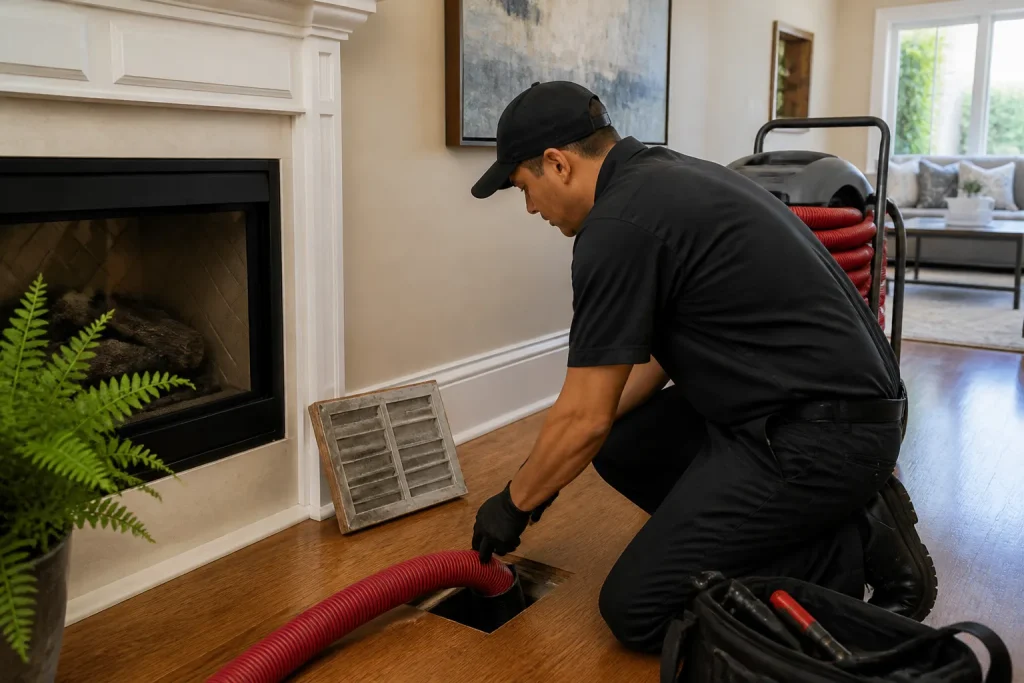
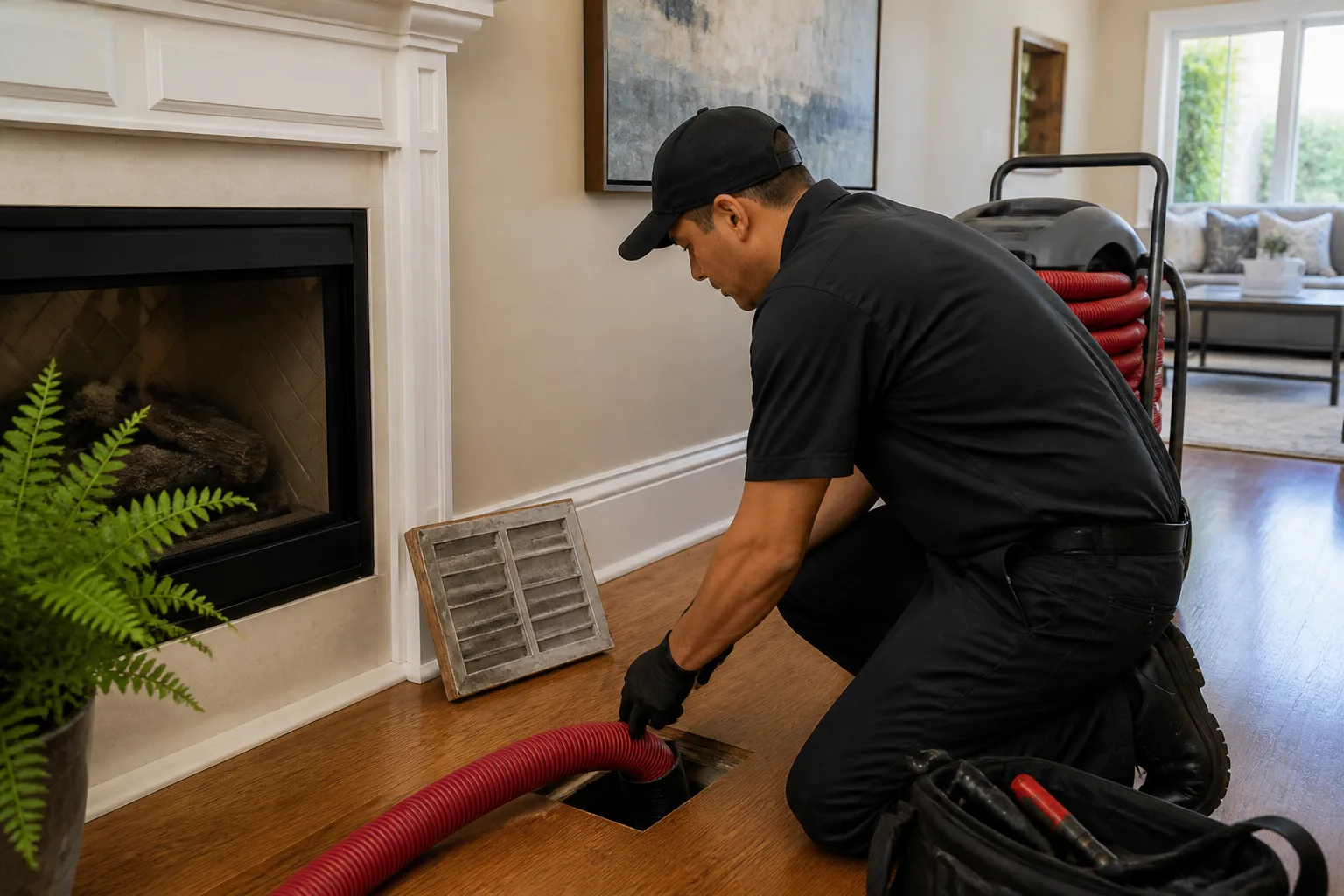
If you’re home during the service, here’s what you should actually see and hear. First, the technician should cut or open access points into the duct system, usually one near the air handler and one at the far end of the trunk line. These aren’t the registers themselves. They’re temporary openings sized for the equipment hose. If the crew never cuts an access point and just works through the floor registers, they’re not doing a full negative-air cleaning regardless of what equipment is in the truck.
Second, the Nikro unit should be connected and running before the brushing starts. The machine makes a steady, deep hum, like a very large vacuum running in the next room. It should stay running the entire time the ducts are being agitated. If the crew runs the brush first and then turns on the collection machine afterward, the negative-air advantage is lost for the period when debris is being dislodged.
Third, the access points should be sealed or at least restricted during operation. Negative air pressure only works if the system is reasonably closed. An open access point at the far end of the trunk is fine, because the air is being pulled through it into the machine. A wide-open hole next to the collection unit defeats the pressure differential. Ask the tech to show you the collection canister after the job. It should contain a visible quantity of material, sometimes several inches of it. If the canister is nearly empty after cleaning ducts that haven’t been touched in two decades, something wasn’t done right.
How to Verify Equipment Claims Before You Book
Plenty of companies list Nikro on their website because the equipment exists somewhere in their warehouse, or they rented it once, or they read the name off a competitor’s page. Here’s how to find out what’s actually on the truck before it parks in your driveway:
- Ask what model of Nikro machine they use. A legitimate operator can tell you the model number without checking anything. A company that’s bluffing will say something vague like “our industrial system” or change the subject to pricing.
- Ask whether the HEPA filtration is at the collection unit or on the brush. The correct answer is the collection unit. If they tell you the brush has a HEPA filter, they’re describing a tool that doesn’t exist, or they don’t understand their own equipment.
- Ask how many negative-air units they bring to a residential job. The right answer is one for most homes, possibly two for larger systems or multiple returns. If they say they don’t need one for your size house, that’s a red flag.
- Ask to see the canister when the job is done. A technician who hesitates or deflects this request is telling you something about what was actually captured.
You don’t need to become an equipment expert. You need to know enough to spot the difference between a company that uses the right tool for the right job and a company that uses the right words on the proposal. Oakland has plenty of both. The questions above sort them out in under two minutes.
Related Services in Oakland
If you’re looking at your air ducts, you’re probably also overdue for dryer vent cleaning. A clogged dryer vent is a fire-risk checklist item, and Oakland’s older laundry rooms often have long vent runs that collect lint exactly where you can’t see it. And if your ducts are damaged, air duct repair addresses the root cause of recontamination. Cleaning a duct with a gaping seam leak is like mopping the floor while the window’s open during a dust storm.
What happens when you call
- 1
A real person answersNo phone trees – you reach a local pro.
- 2
You get an upfront price rangeHonest numbers before anyone is dispatched.
- 3
A background-checked tech heads outLicensed & insured, dispatched right away.
- 4
You approve before work beginsNothing starts until you say go.
The Bottom Line
Nikro air duct cleaning in Oakland is a specific approach, not a generic upgrade. It means the equipment is pulling contamination toward a collection point with HEPA filtration, not agitating it into your living space. It works best when paired with a powered rotary brush that does the actual scrubbing. And it’s verifiable: ask the model number, ask where the HEPA filter sits, ask to see the canister after the job.
If you’re in Oakland and want to know whether your ducts actually need cleaning, Hallmark Air Duct Cleaning home is the place to start. We’ll tell you straight whether it’s worth doing, and if it is, we’ll do it with the right equipment for your system. Free estimates: call (833) 467-6681.
Frequently Asked Questions
Most Oakland homes fall in the $350 to $700 range for a full-system cleaning with negative-air equipment, though larger homes or heavily contaminated systems run higher. Pricing depends on the number of returns, the duct condition, and whether repairs are needed alongside the cleaning. Get a flat quote before work starts, and call (833) 467-6681 for a free estimate specific to your house.
No. Nikro machines create negative air pressure across the entire duct system, pulling air toward the collection point while the ducts are being agitated. A HEPA vacuum attached to a single register cleans only what’s directly in front of it. The difference is system-wide extraction versus spot suction.
Ask to see the collection canister after the job. A legitimate cleaning of a system that hasn’t been serviced in years should produce visible material, often several cups to several quarts. An empty canister on a heavily contaminated system means the equipment wasn’t functioning or wasn’t connected properly.
Negative-air machines apply suction, not pressure against the duct walls. The risk to older ductwork comes from improper access point placement or overly aggressive agitation. A technician who knows Oakland’s older housing stock will inspect the ducts before cutting and adjust the approach to the system’s condition. Call (833) 467-6681 to talk through your specific setup.
Written by the team at Hallmark Air Duct Cleaning, serving Oakland since 2011.
Need Air Duct Cleaning Help?
Call Hallmark Air Duct Cleaning - licensed & insured, here with fast help in Oakland.
(833) 467-6681